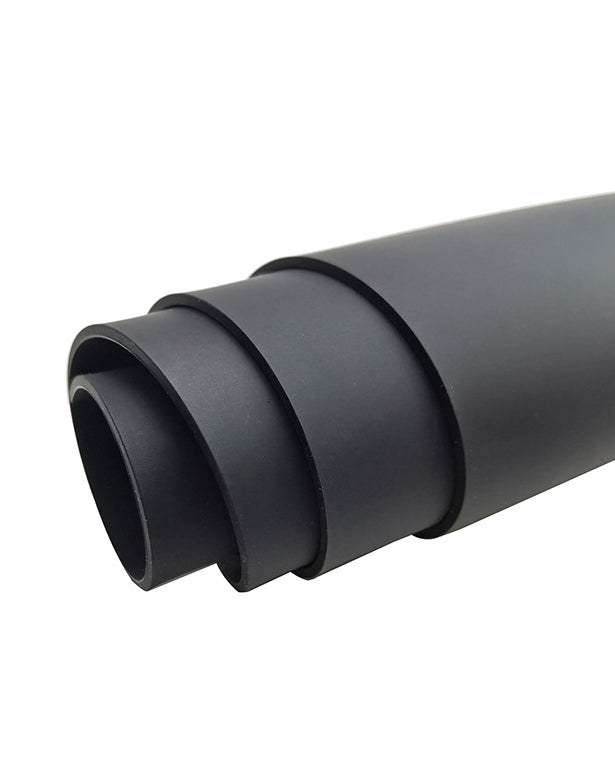


In the field of polymer elastic materials, silicone strips have emerged as a key material in industrial and daily-life scenarios due to their outstanding performance. Their product range includes foamed silicone strips and solid silicone strips. Both are highly consistent in core properties while each excels in specific applications, jointly building safety protection barriers across multiple fields.
1. Core Properties: Weather Resistance, Stability, and Safety
Both silicone strips and solid silicone strips possess remarkable comprehensive performance, enabling them to withstand the challenges of complex environments with ease. In terms of temperature resistance, they can endure high temperatures of 250-300℃ and low temperatures of -40 to -60℃. Even under high-pressure cooking conditions at 200℃, they remain soft and elastic; after a 48-hour high-temperature test, their permanent deformation rate does not exceed 50%, far outperforming ordinary elastic materials in stability. Additionally, these materials exhibit excellent insulation properties, with a breakdown voltage of up to 20-25KV/mm. They also feature ozone and UV resistance, allowing them to adapt to repeated and harsh disinfection scenarios, thus providing long-term reliability for extended use.
Furthermore, silicone strips and solid silicone strips refined through special processes are soft, flexible, and highly resilient. More importantly, they meet non-toxic and odorless safety standards—a characteristic that makes them an indispensable material choice for scenarios with strict safety requirements, such as contact with drinking water and internal components of household appliances.
2. Properties of Subcategories: Application Adaptation Based on Common Traits
(1) Silicone Strips
As a basic category, the core advantage of silicone strips lies in their "broad adaptability." Their resistance to high/low temperatures, high stability, and ability to withstand repeated disinfection enable seamless application across multiple fields. Whether used for heat insulation in electrical products (to protect internal components from temperature-induced damage), sealing internal pipes in drinking water systems (to ensure water safety and prevent leakage), or securing internal connections in industrial refrigeration equipment and gas appliances, they play a crucial role with their reliable performance, serving as a "versatile solution" for cross-scenario applications.
(2) Solid Silicone Strips
As an important branch of silicone strips, solid silicone strips inherit core properties such as temperature resistance, stability, and resilience. Moreover, their robust physical structure allows them to excel in scenarios requiring high sealing and buffering performance. With the same non-toxic and odorless characteristics, they not only meet basic needs like electrical heat insulation and drinking water pipe sealing but also stand out as an ideal choice for scenarios demanding precise adaptation—such as the connection of mechanical components and the sealing of lamps—providing solid support for the long-term stable operation of equipment.
3. Main Application Fields: Comprehensive Coverage from Industrial Manufacturing to Daily Life Protection
With their outstanding overall performance, solid silicone strips have opened up extensive application spaces in multiple fields, acting as a "functional mainstay" for various scenarios.
(1) Packaging and Protection: Buffering Support to Safeguard Products
During product transportation and storage, solid silicone strips serve as excellent "buffering protectors." They are often used as cushioning materials for the transportation of fragile products such as precision machinery, medical equipment, furniture, and glass, effectively absorbing vibrations and impacts during transit to prevent collision damage. Additionally, they can function as protective materials for small electrical appliances, providing cushioning for appliance casings and extending product service life.
(2) Civil Engineering and Construction: Sealing and Stabilization to Strengthen Building Foundations
In civil engineering and construction scenarios, solid silicone strips act as "sealing experts." As joint-filling materials for residential large panels, they tightly fill gaps between panels, effectively preventing air infiltration and rainwater leakage while ensuring the tightness of building structures. As sealing materials for residential doors and windows, they enhance airtightness and watertightness, improving indoor thermal insulation effects and reducing energy consumption. During concrete construction, they serve as anti-shrinkage padding to alleviate shrinkage stress during concrete setting, reducing crack formation and enhancing the stability of concrete structures. Furthermore, they play an indispensable role in sealing, waterproofing, and stabilizing scenarios such as open channels and various civil engineering joints, safeguarding the quality of construction projects.
(3) Automotive and Marine Industries: Sealing and Shock Absorption to Ensure Operational Safety
In the automotive and shipbuilding industries, solid silicone strips are "key supporting components" for ensuring equipment performance and safety. In automobiles, they are widely used for door sealing, luggage compartment sealing, effectively isolating external dust, rainwater, and noise to improve in-car comfort. As buffer pads for engine hoods, they reduce vibrations during engine operation and protect engine components. Meanwhile, they can serve as sealing materials for various pipelines, preventing leakage of oil, water, gas, and other media to ensure normal vehicle operation. In ships, their weather resistance, water resistance, and sealing performance make them suitable for cabin sealing, pipeline sealing, and other parts; they also play a critical role in lamp gap sealing, engine shock absorption, and instrument buffering/sealing, supporting the safe navigation of ships.
(4) Heat Insulation and Thermal Preservation: Energy Conservation to Improve Equipment Efficiency
In heat insulation and thermal preservation scenarios, solid silicone strips act as efficient "thermal insulation assistants." They are often used as heat-insulating sealing materials for coolers, air conditioners, refrigerators, and freezers, reducing heat exchange between the interior and exterior of equipment, improving cooling/heating efficiency, and lowering energy consumption. Their excellent weather resistance and durability ensure stable thermal insulation effects even after long-term use, providing support for the efficient operation of equipment.
(5) Sound Insulation and Moisture Prevention: Environment Improvement to Extend Equipment Service Life
In scenarios requiring sound insulation and moisture prevention, solid silicone strips demonstrate their value as "environment optimizers." As noise-proof sealing materials for various mechanical equipment, they fill gaps in equipment, reducing the transmission of noise generated by mechanical operation, minimizing noise pollution, and improving the working environment. In the construction of residential sound-insulating walls, they enhance the sound insulation effect of walls, isolating indoor and outdoor noise interference and improving living comfort. Additionally, in terms of moisture-proof sealing for various electrical appliances and mechanical equipment, they effectively block moisture in the air from entering the interior of equipment, preventing component damage due to moisture, extending equipment service life, and ensuring stable operation of equipment even in humid environments.
According to the customization process for silicone products provided by Pexxon Rubber, a professional rubber customization manufacturer, standard rubber strips often fail to meet the requirements of special environments in scenarios such as industrial sealing, buffering, and insulation. Customized rubber strips with specific properties have thus become a key solution for addressing complex working conditions. From high-temperature sealing for automotive engines to dust-free buffering for semiconductor equipment, and from food-grade pipeline sealing to thermal insulation protection under extreme temperature differences, customized services must balance three core logics: materials science, process control, and scenario adaptation.
1. Core Customization Parameters
(1) The environmental parameter matrix must clearly define the temperature range as a priority;(2) The quantification of functional indicators must focus on key performance parameters;(3) Certification and compliance requirements must align with industry access standards.
2. Determination of Silicone Types
(1) Methyl Vinyl Silicone Rubber: Cost-effective, suitable for scenarios with temperatures ranging from -40℃ to 250℃ and no contact with special media.(2) High-Temperature Modified Silicone: Modified with components such as phenyl and diphenyl siloxane, its temperature resistance is increased to 250℃-300℃, making it suitable for high-temperature scenarios such as ovens and engine peripheries.(3) Food-Grade Silicone: Made from high-purity raw rubber (impurity content ≤ 0.1%) with no migration of plasticizers or vulcanizing agents, suitable for food contact and drinking water sealing scenarios.(4) Fluorosilicone Rubber: Fluorine atoms are introduced to enhance oil resistance; it can withstand media such as gasoline, diesel, and hydraulic oil, with a temperature resistance range of -60℃ to 250℃. It is suitable for sealing automotive fuel systems and industrial oil pipelines, though its main drawback is higher cost.(5) Medical-Grade Silicone: Features low protein adsorption and low allergenicity, and meets USP Class VI certification. It is suitable for syringe sealing and medical mask components, and must be produced in Class 10,000 cleanrooms to avoid microbial contamination.
3. Confirmation of Process Selection
(1) Extrusion Process: Suitable for long, regular-cross-section silicone strips, enabling continuous production of unlimited lengths.(2) Molding Process: Suitable for irregularly shaped silicone strips and scenarios requiring high dimensional accuracy; it can achieve integral molding of complex structures through molds.(3) Secondary Vulcanization Process: Almost all customized silicone strips require secondary vulcanization (conducted at 180℃-200℃ for 2-4 hours). The purpose is to remove residual vulcanizing agents and low-molecular volatiles, thereby enhancing the temperature resistance and stability of silicone strips.(4) Surface Treatment Process: Customized surface treatment is selected based on requirements: for anti-slip scenarios (e.g., silicone strips for kitchenware), sandblasting treatment can be applied to increase the friction coefficient.