
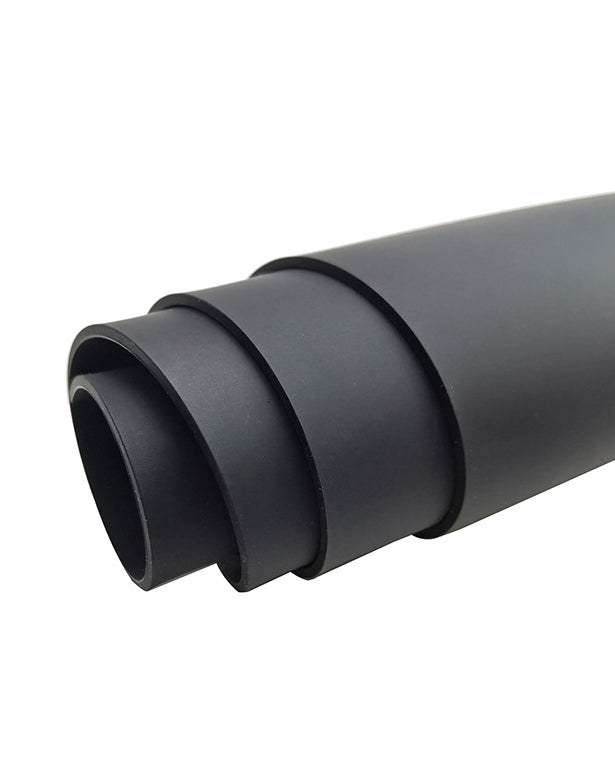


In high-temperature industrial scenarios—such as industrial sealing systems, heating pipelines, and automotive components—EPDM (Ethylene Propylene Diene Monomer) gaskets are widely favored for their exceptional weather resistance and corrosion resistance. However, a common challenge arises: prolonged exposure to temperatures above 80℃ often leads to softening, deformation, and creep, compromising sealing integrity and even triggering leakage risks. The root cause lies in the significant shifts in EPDM’s intrinsic viscoelastic properties under high-temperature conditions. This article delves into the high-temperature viscoelastic behavior of EPDM rubber gaskets, exploring its underlying mechanisms, influencing factors, and practical implications.
1. What is Viscoelasticity in EPDM Rubber?
Unlike rigid materials like metals and plastics, rubber exhibits a unique combination of "elasticity" and "viscosity"—a dual property known as viscoelasticity, which is the cornerstone of a gasket’s sealing performance:
- Elasticity: Analogous to a spring, EPDM deforms under external pressure and reverts to its original shape once the force is removed. This elasticity ensures the gasket tightly conforms to the sealing surface, maintaining a reliable seal.
- Viscosity: Similar to honey, the material undergoes viscous flow during deformation, resulting in energy dissipation. This manifests as phenomena such as stress relaxation and creep over time.
EPDM’s viscoelasticity stems from its molecular structure: copolymerized from ethylene, propylene, and a small quantity of a third monomer, its molecular chains form a tangled, three-dimensional network linked by crosslink bonds. At room temperature, these crosslinks restrict molecular chain mobility, endowing EPDM with robust elasticity. However, elevated temperatures disrupt this delicate balance.
2. How High Temperature Alters EPDM’s Viscoelasticity
Temperature is the primary regulator of EPDM’s viscoelastic behavior, acting by destabilizing molecular chains and crosslink bonds. The mechanism unfolds in three key stages:
Accelerated Molecular Chain Motion Amplifies Viscosity
EPDM molecular chains are in constant thermal motion. At room temperature, their kinetic energy is low, and crosslink bonds dominate, prioritizing elastic behavior. When temperatures exceed EPDM’s glass transition temperature (-40℃ to -60℃)—particularly as they approach or surpass the material’s service temperature limit—molecular chains gain sufficient energy to move more vigorously. This reduces friction between chain segments, enhancing viscous flow characteristics.
Under such conditions, the EPDM gasket transitions from a primarily elastic material to a hybrid of elasticity and viscous flow, with macroscopic signs including softening and a sticky surface texture.
Crosslink Bond Degradation Impairs Elastic Network
EPDM’s elasticity relies entirely on the integrity of crosslink bonds between molecular chains, which have a critical temperature threshold:
- Below 80℃: Crosslink bonds remain structurally stable, effectively constraining molecular chains and preserving the gasket’s shape and elasticity.
- Above 80℃ (and especially at 100℃+): Thermal energy causes partial crosslink bond scission, creating "defects" in the three-dimensional network structure.
As crosslinks break, molecular chains gain greater mobility, further amplifying viscous flow. EPDM’s elastic properties gradually diminish, and the viscoelastic balance shifts decisively toward viscosity—this is the primary driver of gasket creep and permanent deformation.
Stress Relaxation: Gradual Loss of Sealing Force
Stress relaxation is another hallmark of viscoelasticity: during installation, EPDM gaskets are compressed to generate initial sealing stress, ensuring tight contact with the sealing surface. In high-temperature environments, however, viscous molecular flow causes this stress to dissipate over time. Even without visible displacement, the initial sealing force diminishes, eventually creating gaps between the gasket and the sealing surface.
For instance, in automotive engine block sealing applications—where EPDM gaskets operate continuously at 90℃ to 120℃—stress relaxation rates are 3 to 5 times higher than at room temperature. Typically, after 1 to 2 years of service, insufficient residual stress can lead to oil leakage.

3. Practical Risks of High-Temperature Viscoelastic Degradation
Changes in EPDM’s viscoelasticity are not merely material property shifts—they pose tangible threats to sealing system stability, with three key consequences:
Softening and Stickiness Induce Seal Failure
High-temperature softening leaves EPDM gaskets with a sticky surface, increasing the risk of adhesion to sealing surfaces. During disassembly, this can cause tearing and residue buildup. Additionally, softened gaskets exhibit reduced compressive strength, making them prone to "extrusion" under medium pressure—expanding sealing gaps and triggering leakage.
Creep Results in Permanent Dimensional Deformation
Creep is the most striking manifestation of high-temperature viscoelasticity: under sustained compressive stress and elevated temperatures, viscous molecular flow leads to cumulative deformation. Even when temperatures return to normal, the gasket cannot recover its original dimensions. For example, EPDM gaskets in HVAC pipelines operating in 90℃ hot water often experience over 20% compression set after one year, resulting in poor sealing surface contact and water leakage.
Service Life is Significantly Shortened
High temperatures accelerate not only viscoelastic degradation but also aging and cracking. Data indicates:
- At room temperature: Ordinary EPDM gaskets have a service life of 5 to 8 years.
- At 100℃: Service life shrinks to 1 to 3 years.
- Above 120℃ (with corrosive media): Service life may be less than 6 months.
4. Mitigating High-Temperature Viscoelastic Degradation
While viscoelasticity is inherent to EPDM, scientific material selection and operational practices can effectively delay high-temperature degradation:
- Opt for High-Temperature Modified EPDM Formulations: Incorporating reinforcing agents (e.g., carbon black, silica) or adopting peroxide crosslinking technology enhances crosslink bond thermal stability, raising EPDM’s long-term service temperature to 100℃ to 120℃.
- Control Operating Temperature Limits: Avoid using EPDM gaskets beyond their temperature rating. Where necessary, install thermal insulation layers or cooling systems to reduce the gasket’s operating temperature.
- Optimize Installation Practices: Prevent over-compression by limiting compression rates to 20% to 30%. This reduces initial stress and slows creep and stress relaxation.
- Implement Regular Inspection and Maintenance: For gaskets in high-temperature environments, conduct inspections every 6 to 12 months to check for softening, deformation, or leakage. Replace aging gaskets promptly to avoid system failure.

Conclusion
The high-temperature viscoelasticity of EPDM rubber gaskets fundamentally reflects the thermal instability of molecular chains and crosslink bonds. Its core risk lies in disrupting the sealing system’s elastic balance, leading to softening, creep, and eventual seal failure. For engineers and procurement professionals, understanding this mechanism enables precise material selection and optimized usage—extending gasket service life and minimizing equipment operational risks.
In ultra-high-temperature applications (above 120℃), consult professional manufacturers to select customized high-temperature resistant EPDM formulations or alternative materials with superior heat resistance, such as fluororubber or silicone rubber, tailored to specific media characteristics and pressure requirements.