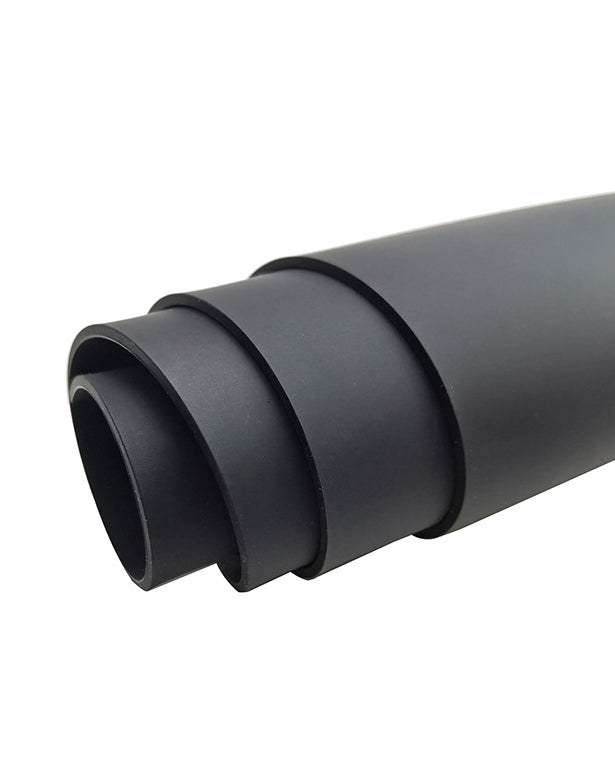


EPDM is a high-performance synthetic rubber that is widely used in industry, construction, automotive, sealing and other fields due to its excellent weather resistance, aging resistance, water resistance, and chemical stability. According to the structural differences, it is mainly divided into two categories: solid EPDM and foam EPDM, which have their own emphasis on performance, application scenarios and advantages, and the following is a detailed analysis from the core dimensions.

Solid EPDM structure features:
The non-porous dense rubber structure is compounded, molded or extruded from raw materials such as EPDM raw rubber, vulcanizing agent, and reinforcing agent, with no bubbles inside and uniform density.
Foam EPDM structure characteristics:
By adding blowing agents, a uniform and porous spongy structure is formed during the vulcanization process, which is filled with tiny bubbles and has a lower density, which is divided into closed-cell foam and open-cell foam.
Solid EPDM Core Advantages:
Outstanding mechanical properties: high tensile strength, high tear strength, can withstand long-term friction, pressure and external force impact, and is not easy to deform;
Good dimensional stability: The dense structure has low shrinkage rate in high and low temperature environments, suitable for scenarios with high precision requirements;
Waterproof sealing duality: both waterproof and can withstand a certain amount of pressure, suitable for scenarios that require sealing and load-bearing requirements.
Typical applications:
Construction field: door and window seals, curtain wall caulking strips, roof waterproof membranes, expansion joint seals;
Automotive field: door frame solid seals, engine compartment high-temperature seals, chassis anti-rock shields;
Industrial field: conveyor belts, shock absorbing pads, equipment linings, pipe sealing gaskets;
Others: Anti-slip mats for outdoor amusement rides, ship deck seals, insulation gaskets for electrical equipment.
Foam EPDM Core Advantages:
High elastic cushioning: can absorb impact energy, reduce vibration, and protect the contact surface;
Lightweight + energy saving: low density, can reduce the overall weight of the product, porous structure has both heat insulation, sound insulation and heat preservation effects;
Good sealing fit: soft and easy to compress, can tightly fill irregular gaps, and the sealing effect in low-pressure scenes is better than solid EPDM;
Closed-cell structure does not absorb water: moisture-proof, mildew-proof, suitable for humid environments.
Typical applications:
Construction field: door and window anti-collision sealing strips, curtain wall insulation strips, wall insulation gaskets, air conditioning pipe insulation layers;
Automotive field: doors, window foam seals, seat shock absorbing pads, engine compartment heat insulation pads, trunk soundproof cotton;
Industrial field: equipment cushioning, instrument shockproof packaging, pipeline insulation jacket, low-pressure sealing gasket;
Others: sports equipment cushion, electronic equipment waterproof gasket, ship cabin soundproof mat, medical equipment anti-slip cushion.

Classification and core differences of foam EPDM:
Open cell foam EPDM:
Structural characteristics: the internal pores are connected to each other like sponges, there are channels running through the pores, there are no closed independent bubbles, and the density is usually lower).
Formation principle: During the vulcanization process, the gas produced by the blowing agent breaks through the rubber matrix, forming a connected pore network, and the bubble wall is not formed.
Open-cell EPDM is an extremely porous material consisting of atmospheric sacs visible to the naked eye. Open EPDM foam is a more porous and permeable material that is not resistant to moisture and absorbs liquids when on contact. The open foam is filled with the surrounding gas. If filled with air, the insulator is relatively good, but if the open battery is filled with water, the insulation performance is reduced. Open-cell EPDM foams are best used for noise isolation because their highly porous open-cell matrix allows sound energy to dissipate within their structure, reducing the noise produced. Additionally, open-cell EPDM foams operate in a temperature range of -40 to 160 degrees Fahrenheit, ensuring they are not damaged when exposed to abrasive temperatures. Despite its porosity and absorbency, open EPDM is a resilient material that is capable of providing long-term applications in industrial settings.
Closed-cell foam EPDM:
Structural characteristics: The internal pores are independently sealed bubbles similar to bubble film, there is no connecting channel between the pores, the bubble wall is intact, and the density is slightly higher.
Formation principle: The gas produced by the blowing agent is wrapped in a rubber matrix, forming independent bubbles that are not connected to each other, and the bubble walls are not ruptured.
Closed-cell foam EPDM is characterized by its smaller and tighter air bag structure. It is denser than open-hole material, but still light enough to float on water. One key property of closed-cell EPDM foam is its exceptional resistance to moisture, aided by its tight structure. Closed-cell EPDM has an absorption rate of less than 5%, allowing it to retain surface moisture for longer without penetrating the material without absorbing moisture immediately. Additionally, closed-cell EPDMs operate in temperatures ranging from -40 to 200 degrees Fahrenheit, slightly lower than the -40 to 212 degrees Fahrenheit of solid EPDMs. Due to these properties of closed-cell EPDM foam, it is a highly regarded material that is often used in outdoor marine environments.
Properties of foam EPDM:
Elasticity: Foam EPDM exhibits exceptional toughness, capable of repeatedly compressing and rebounding without losing its original shape or mechanical properties. This durability makes it ideal for applications that require cushioning or shock absorption, such as car seats, gaskets, and insulation pads.
Weather Resistance: Foam EPDM itself is resistant to weathering, UV rays, and ozone exposure, making it suitable for outdoor applications with long-term exposure to harsh environments. This weather resistance ensures long-term durability and performance in applications such as window sealing, roof waterproofing membranes, and outdoor gaskets.
Thermal Insulation: The closed-cell structure of foam EPDM provides effective insulation properties, helping to reduce heat transfer and energy loss. This makes foam EPDM suitable for insulation in HVAC systems, refrigeration equipment, and building enclosures, contributing to energy efficiency and cost savings.
Chemical Resistance: Foam EPDM is resistant to a wide range of chemicals, including acids, alkalis, and solvents, making it suitable for applications where chemical exposure is a concern. This chemical resistance enhances the durability and longevity of foam EPDM in industrial settings, such as sealing gaskets or tank liners in chemical processing equipment.

EPDM manufacturing and application analysis:
The exceptional properties of EPDM rubber make it resistant to chemicals and weather-related hazards such as UV rays and ozone. As a weather-resistant rubber, this EPDM sheet rubber is commonly used in industrial applications and in machinery exposed to the elements. Compared to other elastomers such as SBR, nitrile or neoprene, damage from rainstorms, pollution and sunlight will occur more slowly than fully exposed EPDM rubber.
EPDM sheets are available in both solid and cellular forms and are materials used in the production of industrial EPDM parts, such as seals, gaskets, and protective pads. Rugged EPDM plates are best suited for heavy-duty applications that are frequently exposed to chemicals, excessive moisture, and constant repeated impacts. Solid EPDM components are ideal for protection applications, absorbing impact forces and protecting surfaces from damage. Honeycomb EPDM panels are better suited for high-compression applications or thermal and acoustic insulation than abrasive industrial applications. Open EPDM boards are best used for insulation because they are extremely porous and better disperse sound energy. On the other hand, due to its absorption rate of less than 5%, closed-cell EPDM sheets can be used in moisture-related applications. Whether solid or cellular, EPDM sheets provide long-lasting and durable industrial rubber components, despite differences in density and structure.
Foam EPDM sheets, including open and closed vias, are often used in applications requiring tighter seals due to their high compressibility. Unlike solid EPDM, EPDM foam is a lightweight and breathable material that is formed by injecting gas into the material during the production process. Closed-cell EPDM foam is a highly moisture-resistant material with an absorption rate of less than 5%, thanks to the smaller air pockets in its construction, while open-cell EPDM is highly absorbent. EPDM sponges, like their solid sponges, are resistant to environmental hazards and maintain a wide operating temperature range, allowing foam EPDM parts to perform well in applications involving abrasive temperatures. Overall, despite its lightweight and airy structure, EPDM foam is a durable industrial material that can withstand applications in high-compression environments, both indoors and outdoors.