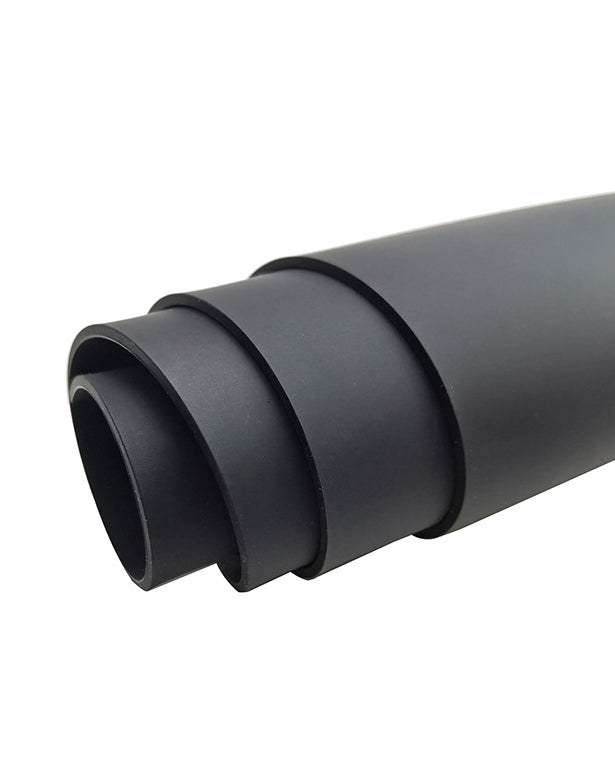


EPDM synthetic rubber is known for its excellent weather resistance, ozone resistance, and chemical resistance. It is widely used in automotive seals, building joints, roof waterproofing membranes and other fields. However, despite its many advantages, EPDM still exhibits some limitations when exposed to high-temperature environments for a long time, such as viscoelastic changes and crack formation. When the equipment needs to operate for a long time in a high-temperature environment, ordinary EPDM rubber gaskets produce viscoelastic changes and cracks at long-term high temperatures, and through scientific rubber customization, these problems are eradicated from the formula and structure to ensure long-term sealing reliability.
1. The viscoelastic change of EPDM rubber gasket at high temperature
Viscoelasticity refers to the fact that a material exhibits both elastic resilience and viscous fluidity under the action of external forces. For EPDM rubber gaskets, long-term high temperatures can lead to the following viscoelastic changes:
Molecular chain degradation and cross-linking failure: High temperature accelerates the breakage of EPDM molecular chains, resulting in the collapse of the rubber elastic network, which is manifested as gasket softening, compression set rate exceeding the standard by >30%, and losing the sealing rebound ability.
Plasticizer migration and volatilization: The plasticizer in ordinary EPDM formulations is volatile at high temperatures, resulting in stickiness on the surface of the gasket, sticking to the equipment flange, making subsequent disassembly difficult and the sealing surface damaged.
Creep accumulation: The viscoelastic characteristics of EPDM at high temperatures are prominent, resulting in continuous creep under long-term compressive loads, gradual thinning of gasket thickness, and insufficient sealing pressure.
Increased rigidity: At high temperatures, the molecular structure of rubber may partially cross-link or degrade, resulting in a decrease in the viscosity of the rubber, an increase in rigidity, and a weakening of elasticity.
Thermal aging: In high-temperature environments, the molecular chains of EPDM rubber may break, leading to hardening of the material and loss of its original elasticity.
However, in a long-term high temperature environment that continues to exceed 100°C:
Polymer chain breakage: Heat energy continuously attacks the rubber molecular backbone and cross-linking bonds, causing them to break.
Plasticizer volatilization and migration: Plasticizers and small molecule additives in the formula will gradually volatilize and be lost.
Specifically, the compression set rate increases sharply, cannot return to the original height, and loses the resilience, resulting in a decrease in sealing pressure until leakage.
2. Crack problem of EPDM rubber gasket at high temperature
EPDM rubber gaskets may crack in addition to viscoelastic changes during long-term high-temperature use. Cracks are associated with:
Thermal Stress: At high temperatures, the thermal expansion and contraction of EPDM rubber can lead to the accumulation of surface stresses, eventually triggering cracks.
Thermal Oxygen Aging Embrittlement: Prolonged exposure to high temperatures and oxygen can lead to oxidation reactions in the molecular structure of EPDM rubber, leading to material embrittlement and crack formation. The oxidation process begins by forming tiny hardening and brittle points on the surface of the material. Over time, these brittle points are connected by repeated stress (such as thermal expansion and contraction, vibration), forming microcracks visible to the naked eye. Microcracks will become the new oxidation frontier and continue to extend into the material.
Stress concentration superposition: The assembly stress at the edge, opening, or installation of the gasket will accelerate crack propagation at high temperature, and eventually form a penetrating crack.
Synergistic erosion of the medium: In a high-temperature environment, if it is exposed to oil, acid and alkali media at the same time, it will accelerate the swelling or degradation of the rubber, further reducing the crack resistance.
Ultraviolet Action: Under direct sunlight, ultraviolet radiation can also accelerate the aging process of rubber, resulting in microcracks or cracks on the surface, which not only affects the appearance of rubber gaskets.

3. How do customized rubber products solve the problem of viscoelasticity and cracks at high temperatures?
Under long-term 120°C~200°C high temperature working conditions, stable EPDM rubber gaskets are produced through three dimensions: formula optimization, structural design, and process upgrading, which fundamentally solves the problems of viscoelasticity and cracks:
Substrate modification: EPDM raw rubber with high ethylene content and high Mooney viscosity of more than 50% is selected, combined with carbon black and silica composite reinforcement system to improve mechanical strength and creep resistance at high temperatures.
Optimization of anti-aging system: adding high-efficiency heat-resistant oxygen resistant agents and ultraviolet absorbers to inhibit molecular chain degradation can increase the long-term upper limit of temperature resistance of EPDM to 150°C~180°C;
Plasticizer substitution: using high-temperature resistant synthetic ester plasticizers, the volatilization loss rate is reduced by 60%, avoiding abnormal viscoelasticity of the gasket;
Special additives added: add anti-tearing agents and cross-linking agents according to working conditions to improve the toughness of rubber and improve the crack resistance by 3-5 times.
Thickness and hardness matching: Customized thickness according to 0.1~2.0MPa equipment pressure, recommended hardness Shore A 65~75 degrees, balance sealing pressure and elastic recovery;
Edge and opening optimization: Adopt an arc transition design for the parts prone to stress concentration, and add a reinforcement ring at the opening to reduce the crack breeding point.
Composite structure design: for 180°C~200°C ultra-high temperature working conditions, customized EPDM combined with fluoroelastomer surface composite gasket, the outer layer is temperature resistant and anti-stick, and the inner layer is sealed and rebounded;
Pre-compression treatment: The gasket is maintained for 72 hours at simulated working temperature, and the creep stress is released in advance, and the deformation rate ≤ 15% after use.
Vulcanization process optimization: The first stage of 160°C×20min, the second stage of 120°C×4h vulcanization is used to completely eliminate internal stress and improve dimensional stability; A high-strength and heat-resistant carbon-carbon crosslinking network was constructed using a peroxide vulcanization system, which significantly reduced the compression set at high temperature.
Surface treatment upgrade: Plasma spraying or silane treatment reduces the viscosity of the gasket surface and enhances the fit with the sealing surface.
Precision molding process: ensure that the compound is fully vulcanized and has no internal defects, forming a uniform and stable cross-linked structure, and eliminating internal weaknesses caused by improper processing.
4. Customized selection guide for high-temperature EPDM gasket
Customized Scheme A: Conventional modified EPDM formulation, pre-compression
Working condition temperature: 120°C~150°C
Core advantage: cost-effective
Applicable scenarios: ordinary pipes, electronic equipment sealing
Customized plan B: high ethylene EPDM, composite reinforcement system, arc structure
Working condition temperature: 150°C~180°C
Core advantages: creep resistance, tear resistance
Applicable scenarios: chemical reactors, automobile engine parts
Customized scheme C: EPDM and fluoroelastomer composite structure, special additives
Working condition temperature: 180°C~200°C
Core advantages: temperature resistance and stickiness, long-lasting sealing
Applicable scenarios: high-temperature valves, boiler equipment
Customized Scheme D: Medium-resistant EPDM formulation and fluoroelastomer surface
Working condition temperature: high temperature oil, acid and alkali medium
Core advantages: anti-swelling and anti-degradation
Applicable scenarios: petrochemical, acid-alkali storage tanks
5. The advantages of professional customization
Accurate matching of working conditions: avoid the mismatch of room temperature gaskets under high temperature conditions, and reduce the risk of failure from the root;
Cost is more controllable: custom gasket service life is increased by 3-5 times, reducing replacement frequency and downtime losses;
Technical support: Provide free working condition analysis, sample testing, and after-sales technical support, worry-free throughout the process